Start from the lesson, not from the desks
The usual question is put the wrong way round. There is no single best layout, only the layout that suits what the lesson is for.
- Rows or pairs support independent work. According to research reviews, time on task is higher in rows than at group tables, and the benefit is largest for the students who find concentrating hardest anyway.
- Group tables are the right choice when the task is a shared one. The same table shape during individual work turns into conversation quickly — not because the students are badly behaved, but because faces turned towards each other are an invitation to talk.
- A U-shape serves a whole-class discussion: everyone can see everyone. In rows the back row easily drops out of the conversation, even when it is otherwise following the lesson.
Each of these layouts — and five more, with how many desks they fit in an ordinary room — is compared in the guide to classroom layouts.
The practical conclusion is the one that makes seating laborious: one layout is not enough. You need two or three — the basic seats, a group work layout and an exam layout — and all of them have to be available without reassembling the puzzle every time.
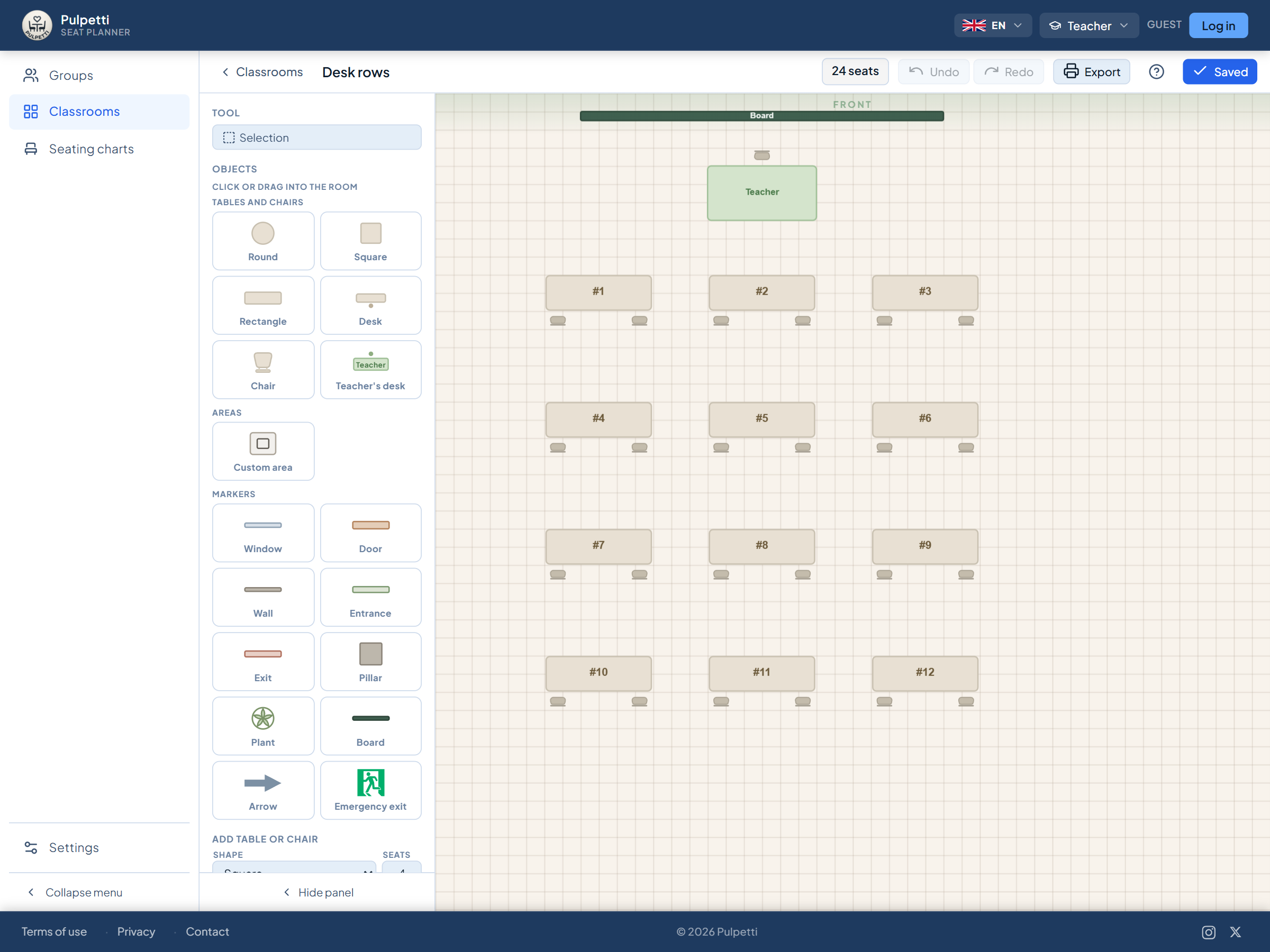
In Pulpetti's classroom tool you make the layouts for the different situations once and open the one the lesson needs: rows of desks, group tables and the exam arrangement are all saved on the same class at the same time.
The seats are worth deciding yourself
Letting students choose their seats freely feels fair, but it repeats the friendships the class already has and leaves out the students who have fewest of them. In studies, disruptive behavior has been clearly more common in freely chosen seats than in teacher-assigned ones — in one often-cited study, three times as common. Teacher-assigned seats, on the other hand, have increased new friendships across gender and background boundaries.
Tell the class briefly that the seats are the teacher's decision and that they change regularly. A general explanation is enough — an individual student's placement is not explained within earshot of the others.
Three decisions before anyone is seated
These are worth writing down before the first name, because they apply to every layout for the whole school year.
- Who must not sit side by side. When teachers are asked, this is by far the most common reason for choosing seats. Mark pairs, not individuals: the problem is rarely one student, most often a combination of two.
- Who needs a seat at the front. Eyesight, hearing and concentration are the obvious reasons. The less obvious one is that a teacher's gaze and questions naturally land at the front and in the middle — a front seat is not only for hearing, it is for taking part.
- Who sits next to whom. The neighbor effect is not only about the restless student: those sitting next to a restless student have scored lower in measurements. Choosing the neighbor is therefore just as much the quiet student's business.
Two approaches that sound good but do not work
Seating a quarrelling pair together in the hope of reconciliation. The idea is tempting, and one to one it can even work. When it was tried across whole classes — in a Dutch experiment covering 59 fifth-grade classes — the result turned the other way: open aggression increased and students rated cooperation in the class as worse than in the control classes. Separating is a controlled solution; forced closeness is not.
Seating someone alone as a punishment. A seat set apart from the others is visible to the whole class. An isolated seat is associated with a worse reputation among peers: more mentions of fighting and of annoying the teacher, fewer mentions of being pleasant and cooperative. A desk of one's own is a good working solution for a student who needs it — a poor sanction.
How often the layout should change
The person next to you becomes a friend. In a study following primary school pupils, those sitting close to each other named each other as friends 3–5 times more often than others, and when seats were moved closer together, the likelihood at the next measurement was 8–10 times higher.
That gives a practical rule in both directions. Changing too often does not have time to produce anything: relationships form over weeks, not days. Changing too rarely leaves the class in the same pairs for a whole year. A term, or roughly 6–8 weeks, is a workable rhythm for the basic seats.
A task-specific layout is a different matter. A group work layout may change mid-lesson, and that is not the same as changing the basic seats — same students, same framework of rules, different arrangement.
A six-week rhythm means a new layout five times a school year. It stays light once the rules have been stated once: the classroom seating tool shares the seats out again according to them, and you are not starting from anywhere.
An exam layout solves a different problem
In an exam the aim is not group dynamics but distance and line of sight. In practice that means one empty seat between students as far as the room allows, gazes directed away from the neighbor's paper, and a walkway that lets you reach every desk without interrupting anyone else.
Make the exam layout a saved arrangement of its own rather than a one-off shuffle. Exam week comes every term, and pushing the desks into place in the morning is exactly the work that can be done once — the same class can hold several layouts, so the exam layout is waiting for the next exam too.
The layout has to be one somebody else can read
A substitute teacher, a teaching assistant or a student starting mid-year does not know the history of the class. A few rules make the layout usable without you as well:
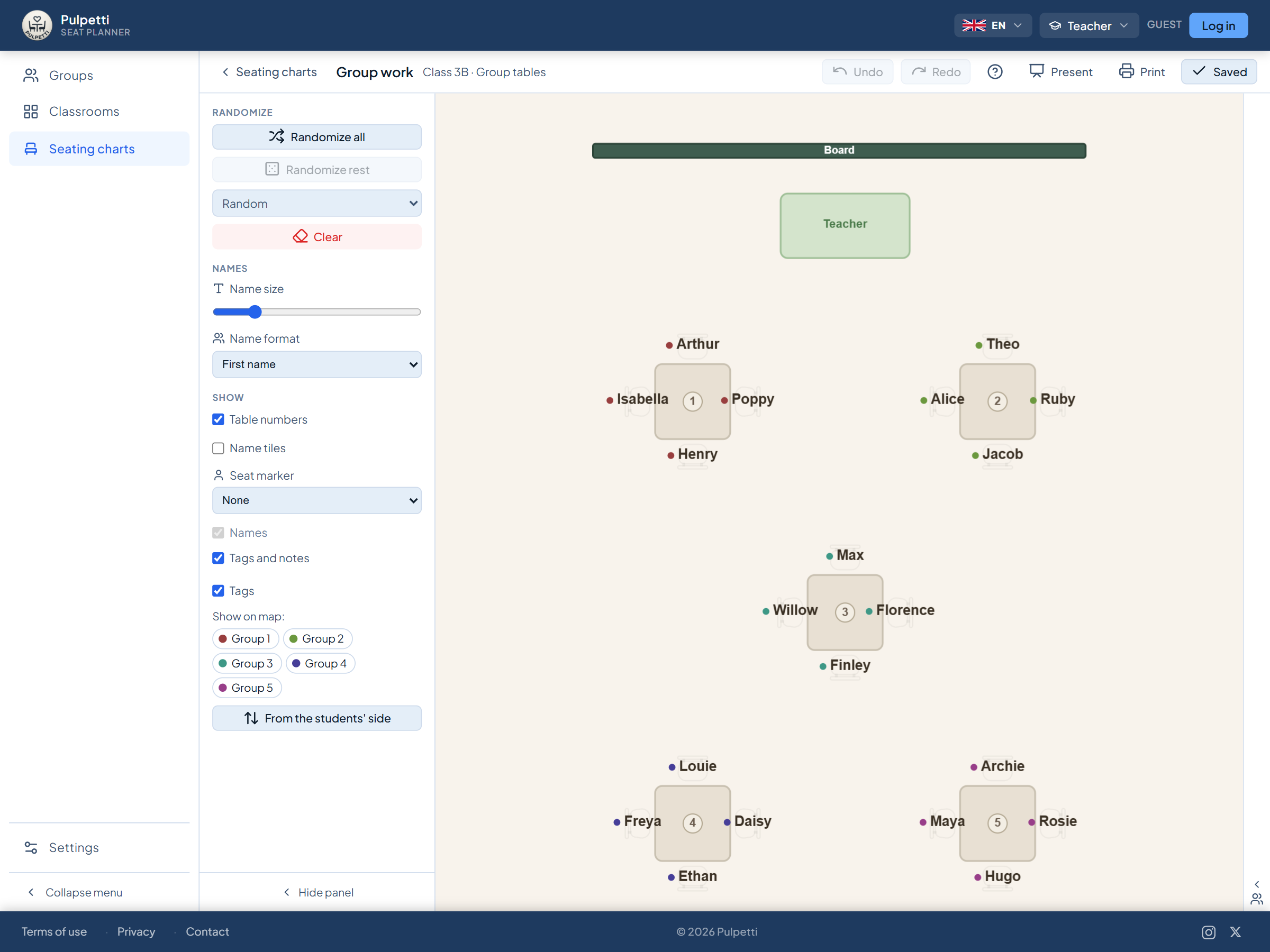
- The chart shows names, not codes or numbers.
- The reason behind a seat is recorded briefly and plainly — needs a seat at the front is enough.
- Diagnoses, health information and judgments about a student's character are not recorded in a seating chart. They do not belong there, and the chart often ends up in more adults' hands than you expected.
How the decisions stay in force
So far this guide has covered what is worth deciding. The hardest part, though, is that the decisions still hold next month, in the next piece of group work and on the morning there is a substitute teacher in the room. Pulpetti was built for that gap.
- Rules belong to the group, not to one chart. You say once who must not sit side by side, who works well together, who needs a seat at the front and who works at a desk of their own. They apply to every layout for that class afterwards — including the ones you make in December.
- Rules that separate are absolute, rules that gather do their best. Exactly the way round the research points: separating is a controlled means, forcing people together is not. If the room runs out of space, the app tells you about the conflict in plain language instead of quietly seating someone wrongly.
- A new layout takes seconds. At the turn of a term you do not rebuild anything: you press the draw, and the class settles into new seats according to the same rules. You can also place whoever you like yourself, lock them and let the app fill the rest.
- The same class, several layouts. The basic seats, the group work layout and the exam layout all exist at the same time and stay saved. Exam week starts by opening the exam layout, not by pushing desks.
- The classroom is drawn once. A ready-made desk layout or rows of your own, real dimensions in meters or feet if you want them, windows and the door in place. You tell the app which way the room faces, so the front-row rule knows where the front row is — and the chart can be turned to be read either from the teacher's side or from the students'.
- The names come from a list in one go. Copy the class list and paste it as a single block, one name per line. No other personal data is needed.
- The reason behind a seat stays recorded. A student can be given a short note and a tag, so the reasoning is not only in your memory when somebody else looks at the layout.
- A substitute teacher is left with a readable chart. The printout shows the names in their places, and if you want, the students' photos can come along — a substitute recognizes the class in the first lesson. Printing and PDF belong to the paid plans; on the free plan the design tools and the rules are available, but the limit is 15 people per setting, which is not enough for a class.