Start from who gets on together
Formal rules are a useful aid, but they are not the starting point. The starting point is that a conversation happens at every table. In practice that means gathering the natural sets first — family, university friends, colleagues, childhood friends — and only then working out which of them are worth putting at the same table.
A few rules of thumb help:
- At least one familiar face at every table. Nobody should spend the evening at a table where they know no one.
- Mix the sets thoughtfully. Two groups at one table works when there is some natural connection — a similar age, a shared hobby, both knowing the groom from the same summer job.
- A talkative guest next to a quieter one. It carries the conversation for the whole table.
- If someone is better seated at a different table from someone else, decide it in advance and write it down. That is an ordinary part of planning rather than a problem — and once it is written down, it does not get forgotten by the time the chart is made for the third time.
The sets and the wishes are worth recording the very first time round. In Pulpetti's wedding chart tool you tag the guests with their set and state the wishes once, and they still apply in the second and third versions.
The head table and the alternatives
At a traditional Finnish head table the couple sit in the middle with their parents beside them. The order goes like this:
- The bride sits on the groom's right.
- The bride's father sits on the bride's right, and the groom's mother on the bride's father's right.
- The bride's mother sits on the groom's left, and the groom's father on the bride's mother's left.
The tradition is worth knowing, but it is one option out of four:
- A head table gives the couple and the parents a place of their own and is clear when there are two families and the line-up is straightforward.
- One long table suits a small celebration where everybody fits around the same table.
- A horseshoe, or U-shape, keeps the guests close to each other and the couple in view of the whole room.
- The couple at a table of their own or at an ordinary table among the guests is common these days. It is also the most flexible solution when there are many close relatives and one table will not hold them all.
The classic rule of etiquette is that spouses and siblings do not sit side by side — at weddings, however, this is commonly set aside and married and engaged couples are seated together. Decide the line once and stick to it across the whole chart, and the result will look considered.
The size of the table decides the conversation
The same number of guests at different sized tables produces a very different evening. At a round table the conversation carries across the whole table as long as the distance to the person opposite is short enough: at a table of eight everyone can talk to everyone, while at a table of ten the person opposite is already a meter and a half (5 ft) away — in practice out of conversational reach. Ten will fit, but the table splits into two conversations.
At a long table the conversation always happens with your neighbors and the person opposite. That is why a long table is decided by the group of three around you rather than by the whole table — and why it is more forgiving: one well-judged pair of neighbors is enough.
The standard sizes are 60 inches (150 cm) for eight and 72 inches (180 cm) for ten. Every diameter, both units and the arithmetic behind the numbers have a guide of their own: how many people fit at a round table.
The place setting and the decorations take up room. If a table is marked for ten seats and the setting includes a napkin, glasses and a flower arrangement, it is worth counting the seats once more before the place cards are printed.
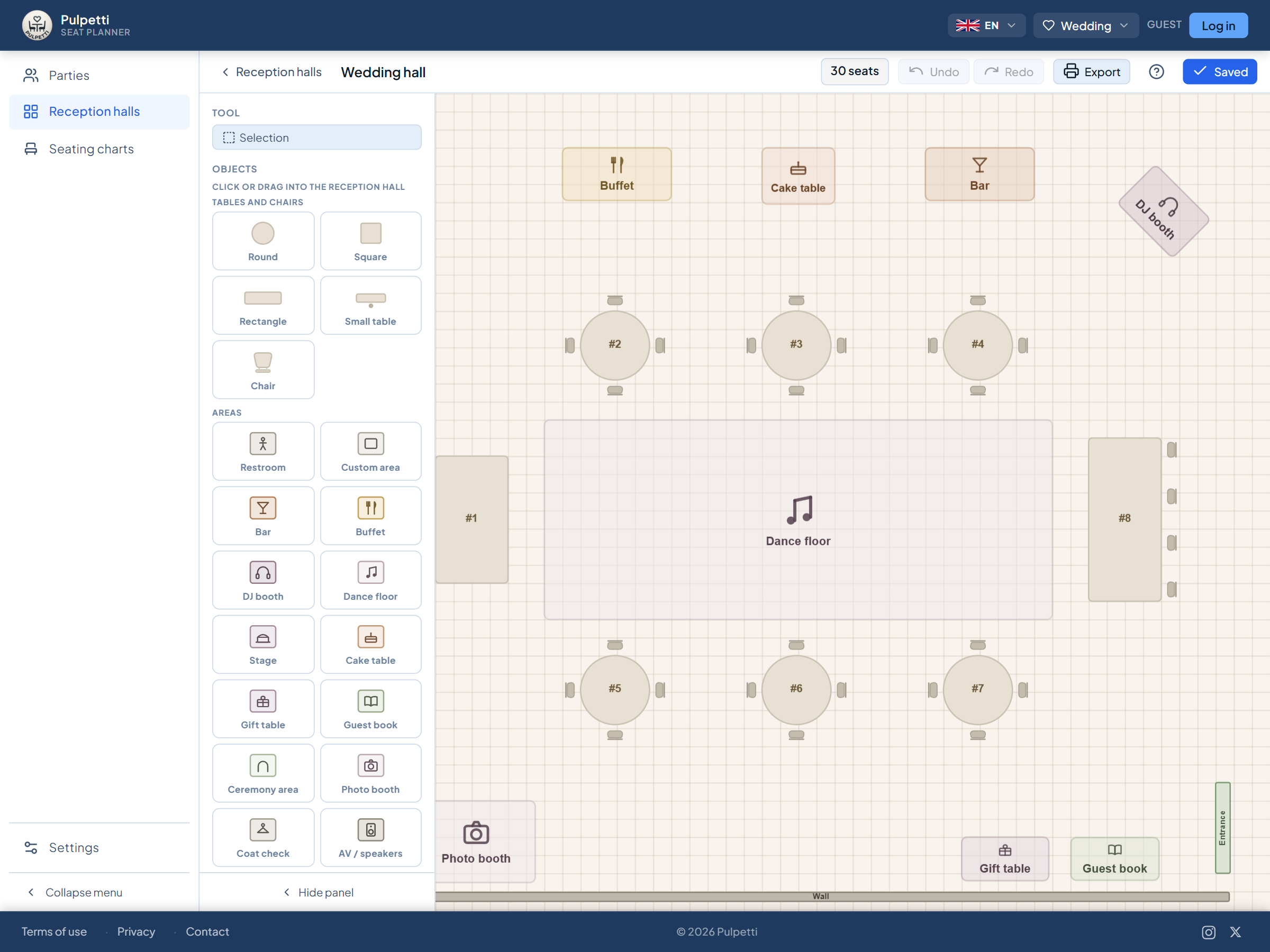
The easiest way to see the difference is to try both: when you draw the room as a wedding chart and change a table's seat count from eight to ten, you see straight away how many tables the room needs and how roomy it looks.
Whose seat is chosen separately
Most guests can sit almost anywhere. A few groups cannot:
- Children close to their own parents, preferably on the exit side and away from the speakers. If there are several tables of children, keep the tables next to each other — then one adult can see them all.
- Elderly guests away from the speakers, close to an aisle and to the toilets. Hearing the speeches is often the most important thing of the evening for them.
- Guests using mobility aids at an end seat with a clear walkway beside it. Size the walkway so that it can still be used when all the chairs are pulled out.
- Dancers near the dance floor and those in for a quieter evening further away. It is a small thing that shows in the atmosphere right after the first song.
When the chart is made and when it is locked
The timeline is the most underrated part of seating. A workable rhythm looks like this:
- RSVP date 3–4 weeks before the wedding. A week or two is not enough: there has to be time to ring the people who have not replied, and the caterer wants the final number about two weeks in advance.
- The first chart when about 80% have replied. By then the number of tables and the line-ups are clear, and the rest are seated as the replies come in.
- Lock the chart down 2–3 weeks before, that is right after the RSVP date. After that you only make corrections, not a new chart.
Be prepared for some of it to change even then: experience of running celebrations says that roughly one reply in ten is still moving at the last minute, and most of the changes come in the final three days. That is not a sign of poor planning but a normal part of a wedding.
A single cancellation is not worth reprinting everything for. Take the place card off the table, tell the venue staff about the change and leave the door list alone — a guest who is not coming is not looking for their name.
If several changes come in, a tool built for wedding seating saves you a whole round: you mark the cancellations, lock the seats already agreed and share out only the ones that came free.
Place card, door list or both?
These three often get mixed up, even though they do different jobs:
- The door list tells a guest which table they are at. It is an alphabetical name → table number list or a board at the reception.
- The table sign says which table this is, and helps it be found from the other side of the room.
- The place card says which seat at the table is whose.
The most important rule: place cards alone are not enough. Without a door list or a board, guests wander from table to table looking for their name and the welcome drink stretches into a quarter of an hour. A door list without place cards, on the other hand, works well if guests may sit where they like within their table.
How one chart carries all the way through
A wedding chart is not one decision but a series of decisions that have to be remembered in every version. That is exactly what Pulpetti is built for.
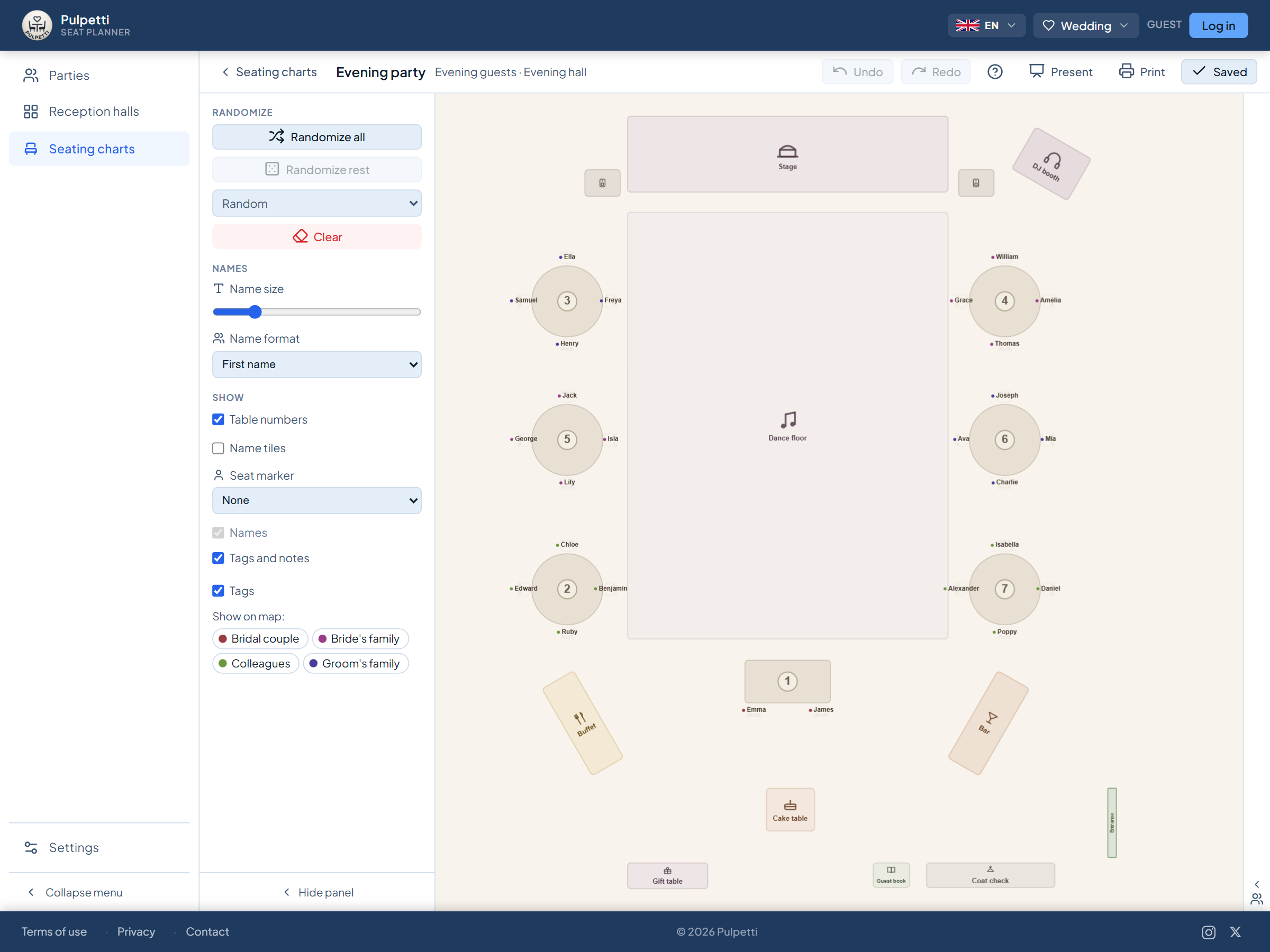
- Record the sets once. Give the guests a tag — the bride's family, the groom's family, university friends — and ask the app to keep guests with the same tag at the same tables. The grouping is flexible: it gathers a set together but lets an individual guest sit elsewhere if they belong more naturally at another table.
- The wishes apply in every version. You say once who sits at the same table, who sits side by side and who goes to separate tables. When you make the chart again, the same wishes hold without your remembering them.
- The head table is an ordinary table that you name yourself. You seat the couple and the parents there by hand, lock the seats and let the app share out the rest of the room.
- A cancellation does not start from scratch. Set the guest's status to "Not attending" and they drop out of the seating but stay on the list. Locked seats stay put, and only the seats that came free are shared out again. If a seat has already been given to someone who canceled, the app points it out.
- Several versions side by side. The same guest list and the same room can carry several charts, so you can compare two options without losing either.
- Special requirements recorded, out of sight. An allergy or "cannot hear on the left" can be written as a note on the guest. It does not affect the seating and does not appear on printouts unless you deliberately include it.
- All four papers from the same chart. Place cards with fold lines, table signs, the alphabetical door list and the room's floor plan for the venue staff — the same stationery that would otherwise be bought separately. Printing and PDF belong to the paid plans.