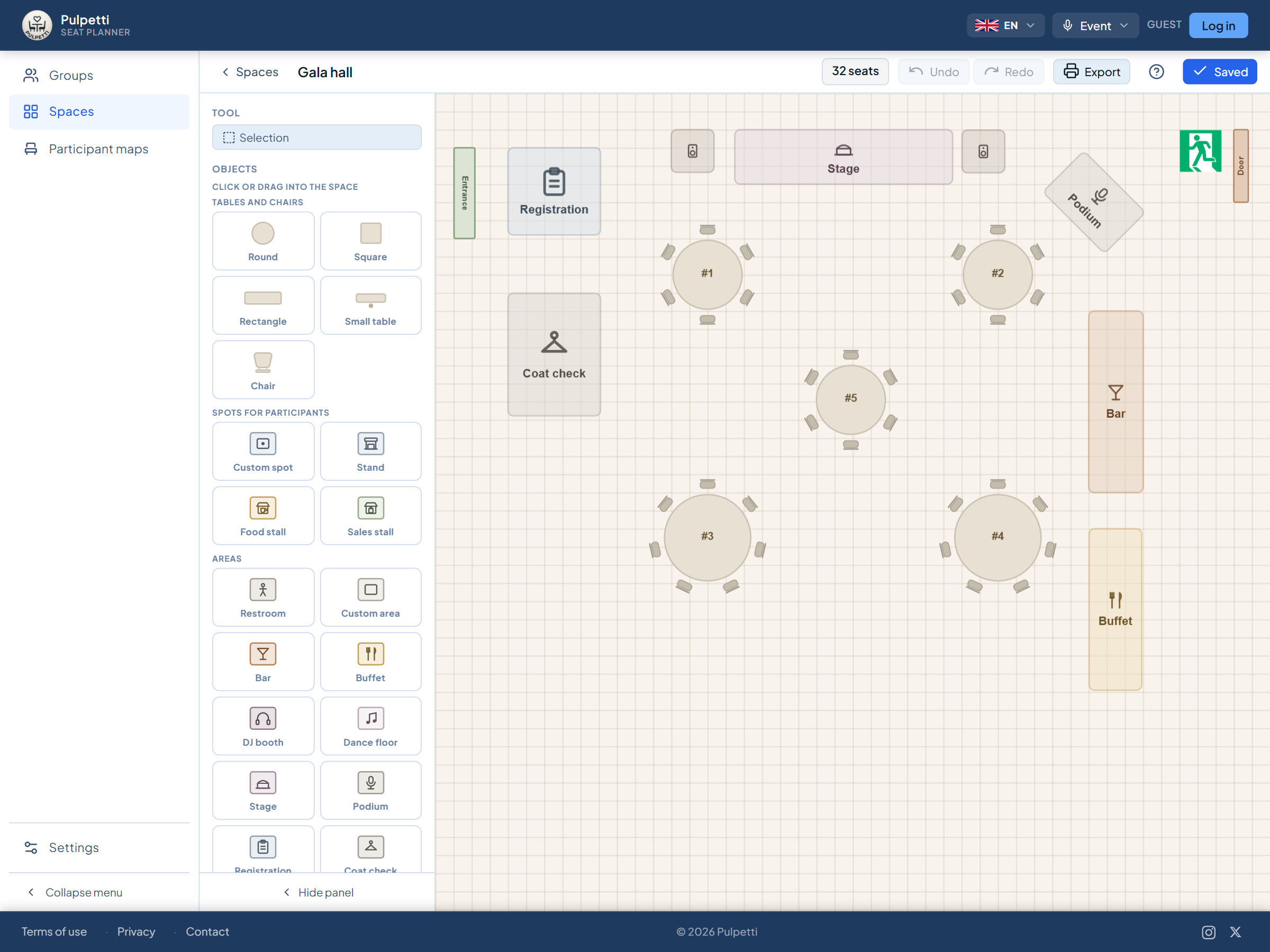
Choose the layout style by what the evening is for
The same room holds very different numbers of people depending on how it is laid out — and every style does one thing well and another badly.
- Round tables (banquet), 8–12 people. Best for conversation and for eating, roughly 1.1–1.3 m² (12–14 sq ft) per attendee. The price is paid at the stage: at every table two or three people sit with their backs to the performer.
- Cabaret, or half a table, 5–8 people. The stage side of the table is left open and everyone sits facing the stage, so nobody has to turn round. It needs roughly 1.2–1.5 m² (13–16 sq ft) per person and in practice 30–40% more space than a banquet for the same number of people: a table for eight seats five or six in cabaret style. Seat counts by diameter, the staggering and the floor space are in a guide of their own: cabaret style seating.
- Classroom style gives everyone room to write and suits a training day, but not a meal and not a conversation.
- Theater style without tables holds roughly twice as many people in the same space (about 0.7–0.9 m², or 7.5–10 sq ft, per person). It is the right choice for a program, not for a dinner.
The answer follows the main event of the evening: if the heart of it is on the stage, cabaret or theater; if the heart of it is at the tables, banquet. If the choice is open, it is worth drawing both: in the event seating tool the same room can be laid out two ways side by side, and the seat counter tells you what the difference costs in seats.
Allow space for more than the tables
The area the tables take up is not the whole story. Add 20–30% of space to the calculation for service, the buffet, the stage, the bar, the cloakroom and the walkways. Without that allowance the plan looks as though it fits, but the room jams at exactly the points where people move most.
Draw the walkways before the tables and make sure a line can form in front of the buffet without cutting off the route to the door. A line will form in any case — where it forms is a design question.
The table assignment decides the evening's conversations
Once the layout is settled, what remains is the part an attendee actually remembers. A few principles work from one event to the next:
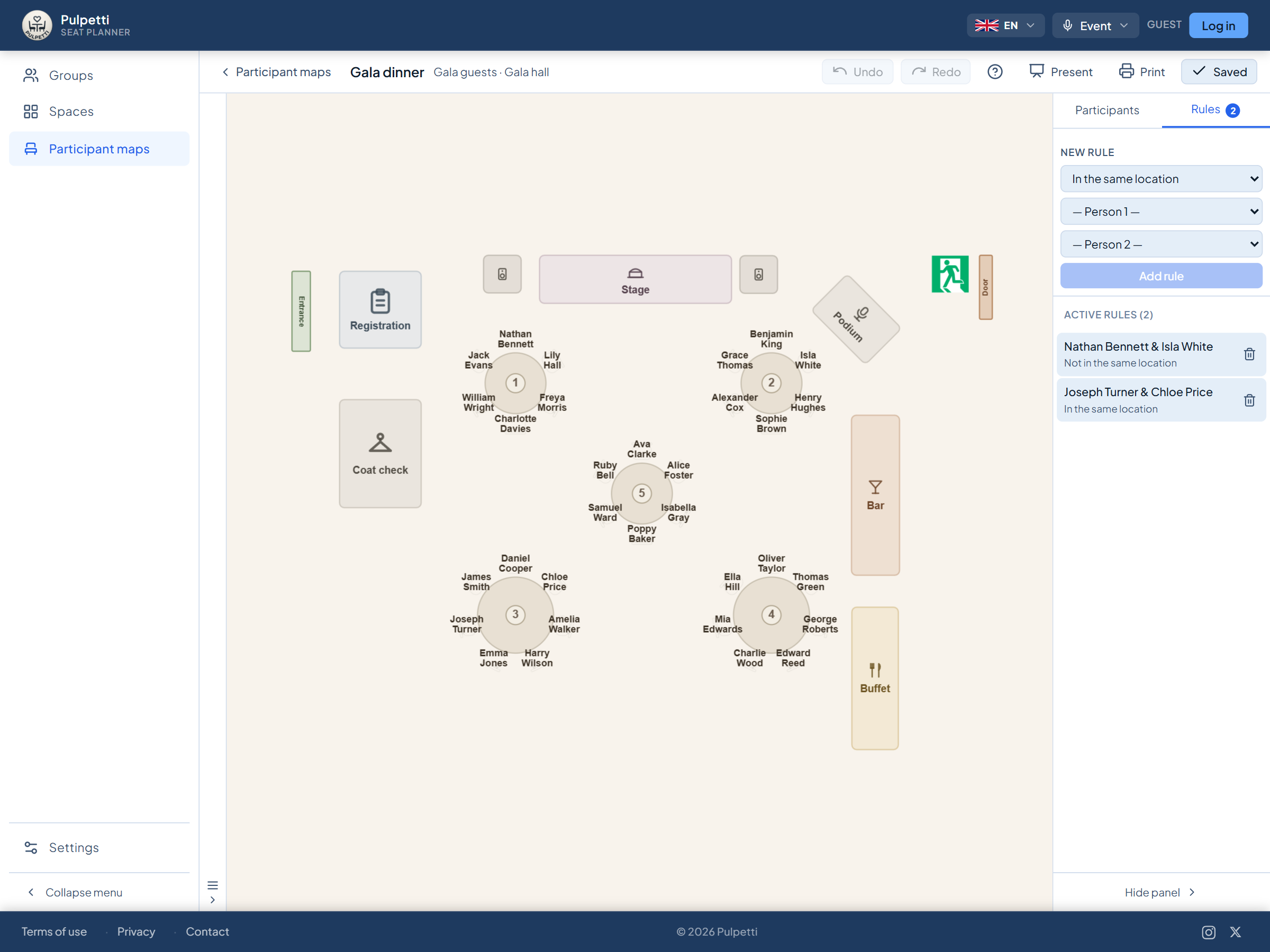
- Do not divide people up alphabetically or in order of registration. That is a random assignment that looks systematic.
- Build the tables around a shared subject. A table of people from the same industry, or wrestling with the same question, gets a conversation going without anyone having to start it.
- Break up large delegations. Ten people from the same organization at the same table spend the evening among themselves — they could have done that at the office.
- One familiar face or host at every table. A person who knows a few of the others carries the table's conversation past the first quarter of an hour.
- A partner's table is a networking table. If a partner is given a table, say what it is for beforehand: a couple of representatives and the rest attendees, not a whole team.
These decisions are worth writing down straight away, because they repeat in every version. In Pulpetti's event chart you mark the sets with tags and state the wishes once, so they still apply when you share the tables out again.
Speakers, guests of honour and the stage
Some seats are decided before all the others:
- Speakers and award recipients close to the stage and on the route to it, preferably at an end seat. Nobody wants to climb past nine people in the middle of their own introduction.
- Guests of honour and main partners at the row of tables in front of the stage, where the view is best.
- Organizers spread around the room. Your own people at their own table is a wasted resource: spread out, they are the ones who carry the tables' conversations.
- Technical equipment and routes are worth marking on the plan, so that nobody ends up sitting in front of a speaker or on top of a cable run.
Registrations keep moving until the last day
An attendee list is never finished. Cancellations come in, replacements are announced in the morning and someone brings a colleague. Prepare for it with structure rather than with redesign:
- Leave 10–15% of slack: a few tables with room and a couple of seats in good positions.
- Put the slack seats at tables with sociable people — a guest registered late ends up in their company.
- Mark cancellations out of the assignment but leave them on the list. The name is still needed at the reception desk and in the invoicing.
From the door to the table without a line
The plan's last job is to steer an attendee to their seat without anyone leading them by the hand. Two things are needed for that: an alphabetical name → table number list at the reception and clearly visible table numbers in the room. Place cards are a third layer, and they are worth making when the order within a table matters — for example when a partner's representatives are to be spread around the table.
Put the door list where two people can stand in front of it side by side without the line blocking the door. If there are a lot of attendees, two points help more than a bigger sign.
How one chart survives the changes
An event chart changes many times before it is final, and every version has to follow the same decisions. Pulpetti was built for that.
- Bring the attendees in as a list. Copy the name column from your registration list and paste it in one go — one name per line.
- Build the room from a template or yourself. The table shape, the size and the seat count per table can all be changed, so a banquet plan can be turned into cabaret style without redrawing anything.
- Tags handle the grouping. Give the attendees a tag — industry, organization, language — and use the rule "same tag, same table", or the opposite, "same tag at different tables", when you want to mix the sets on purpose.
- Lock the seats that are decided. Speakers, guests of honour and partners in their own seats, and the rest shared out again as many times as the list changes.
- A cancellation does not bring the chart down. Set the attendee's registration to "Canceled" and they drop out of the assignment but stay on the list. If a seat has already been given to them, the app points it out.
- The printouts come from the same chart. The door list for the reception, table signs for the tables, place cards for the seats and the floor plan for the staff. Printing and PDF belong to the paid plans.