The traditional order seat by seat
At a traditional head table the couple sit in the middle and the parents beside them. The order goes like this:
- The bride sits on the groom's right.
- The bride's father sits on the bride's right, and the groom's mother on the bride's father's right.
- The bride's mother sits on the groom's left, and the groom's father on the bride's mother's left.
Right and left mean the seated person's own right and left, not the onlooker's. This is where the order usually ends up mirrored: when you look at the table from the guests' side, the bride is on your left. Read from left to right as the guests see it, the seats are:
| Seat | Who | Why there |
|---|---|---|
| 1 | groom's mother | the in-laws side by side |
| 2 | bride's father | next to his daughter |
| 3 | bride | on the groom's right |
| 4 | groom | in the middle with the bride |
| 5 | bride's mother | next to her son-in-law |
| 6 | groom's father | the in-laws side by side |
The logic of the order is that the two sets of in-laws sit next to each other: the bride's father with the groom's mother, the bride's mother with the groom's father. The point is that the evening is spent talking to the family that is only now becoming familiar.
The other tradition is the wedding party head table: the best man, the maid of honour and the rest of the bridesmaids and groomsmen sit with the couple, and the parents get a table of their own out in the room. Either way works. Pick one and stay with it — done half way, someone close to you is left out without an explanation.
Who belongs at the table
A head table for six is the most common, but few families come in sixes. Four questions settle the remaining seats:
- Grandparents. One or two fit at the ends of the head table. If there are six of them, give them a table of their own right next to the head table — that is a better seat than the far corner of the head table.
- Siblings. Siblings do not traditionally sit at the head table unless they have a role in the wedding party. Younger siblings sit next to their own parent, whichever table that is.
- Partners. Anyone invited to the head table brings their partner. If the table will not stretch, leave the couple out together and seat them in the front row — a partner left on their own is remembered far longer than the seating chart is.
- The officiant. Invite them to the head table only if they are a close friend of the family. Otherwise they sit at an ordinary table, preferably near the door, as they often leave before the evening is over.
One rule of thumb keeps the table together: if you find yourself explaining to someone why they are not at the head table, the table is too big rather than too small. At a small head table being outside it is the rule; at a large one it is a choice.
Divorced parents and step-families
This is the part of the head table people actually agonise over, and tradition has no ready answer for it. Three situations cover almost all of them:
They get on well. The traditional order works as it is. A new partner sits next to their own partner, which makes the table two seats longer. This is the clearest solution whenever it is available.
Relations are cool. Leave the head table to the couple and give each parent a table of their own with their own company. What matters is that the tables are the same distance from the couple and preferably on opposite sides of the room. Distance from the couple is read as a ranking, even though nobody says so out loud.
Relations are bad. The same solution as above, but place the tables so that they are not in each other's line of sight all evening — on opposite sides of the dance floor or the buffet, for instance. Record the pair as a rule so it does not get lost the third time the chart is redrawn.
Two things are worth doing whatever the situation. Tell both parents the arrangement before the wedding day — a surprise on the spot is what turns into a row. And keep the children out of the decision: a younger sibling sits with the parent they live with, and is not used to balance the tables.
The couple on their own
A table for two, the sweetheart table, is the most common alternative to a head table. The couple sit alone at the front of the room and the parents get tables of their own.
It settles three things at once: the order for divorced parents, the arguments about who belongs at the head table, and the fact that the couple would otherwise spend the most important conversations of the evening between two sets of in-laws. In exchange, the couple are on their own all evening: a table for two has no other company, and when the couple go round the room the table stands empty.
A 48 × 30 inch (120 × 80 cm) table is enough, or two small ones side by side. Put it at the point in the room from which the couple can see every table — not right against the wall, because then nobody can come round behind the table for a word.
Four models and what they cost
A head table is one of four ways to seat the couple, and the choice is worth making before a single name is placed:
| Model | Suits when | The cost |
|---|---|---|
| Head table | there are two families and the line-up is straightforward | someone is always left out |
| Couple on their own | the parents' situation is complicated | the couple sit alone all evening |
| Couple among the guests | there are many people close to you | the couple are not visible to the whole room |
| Horseshoe or U-shape | there are fewer than 50 guests | takes up more of the room |
The horseshoe deserves a mention of its own, because it solves the head table problem from the other direction: the couple sit at the base of the U, everyone can see them and nobody sits with their back to them. It simply takes up far more floor than the same number of guests in round tables, and the inside of the U goes unused. Under 50 guests it is often the best answer; at a hundred it no longer fits.
Table size and where it goes
A head table is usually seated on one side only, so that everyone faces the room. Each place then takes 24–30 inches (60–75 cm) of table length, and the length follows straight from the number of people:
- 4 people — about 8 feet (2.4 m)
- 6 people — about 12 feet (3.6 m), which is two standard 6-foot banquet tables end to end
- 8 people — about 16 feet (4.8 m)
- 10 people — about 20 feet (6 m), a third of the width of an ordinary function room
Another three feet are needed behind the row so that chairs can be pushed back and people can pass behind the table. A head table for six therefore takes about 12 × 6 feet (3.6 × 2 m) of the room. If the length starts to approach the width of the room, the model is wrong rather than the table too small — that is the point to move to a horseshoe or to give the parents tables of their own.
Four things decide where it goes:
- Sight lines. Against the short wall, with the guest tables fanned out in front of it. Every table needs a clear view of the couple without anyone having to turn in their chair.
- Doors and the kitchen. Not beside the kitchen door or the service route. The head table is the most photographed table of the evening, and a service trolley passing behind it appears in every picture.
- Sound. The speeches are given from the head table, so the speakers belong on either side of it facing out — not pointing at it.
- Distance to the guests. About five feet (150 cm) to the nearest guest table. Further away the head table starts to look detached; closer and there is no room to walk past.
The sizes and seat counts of round guest tables have a guide of their own: how many people fit at a round table.
How to do it on the plan
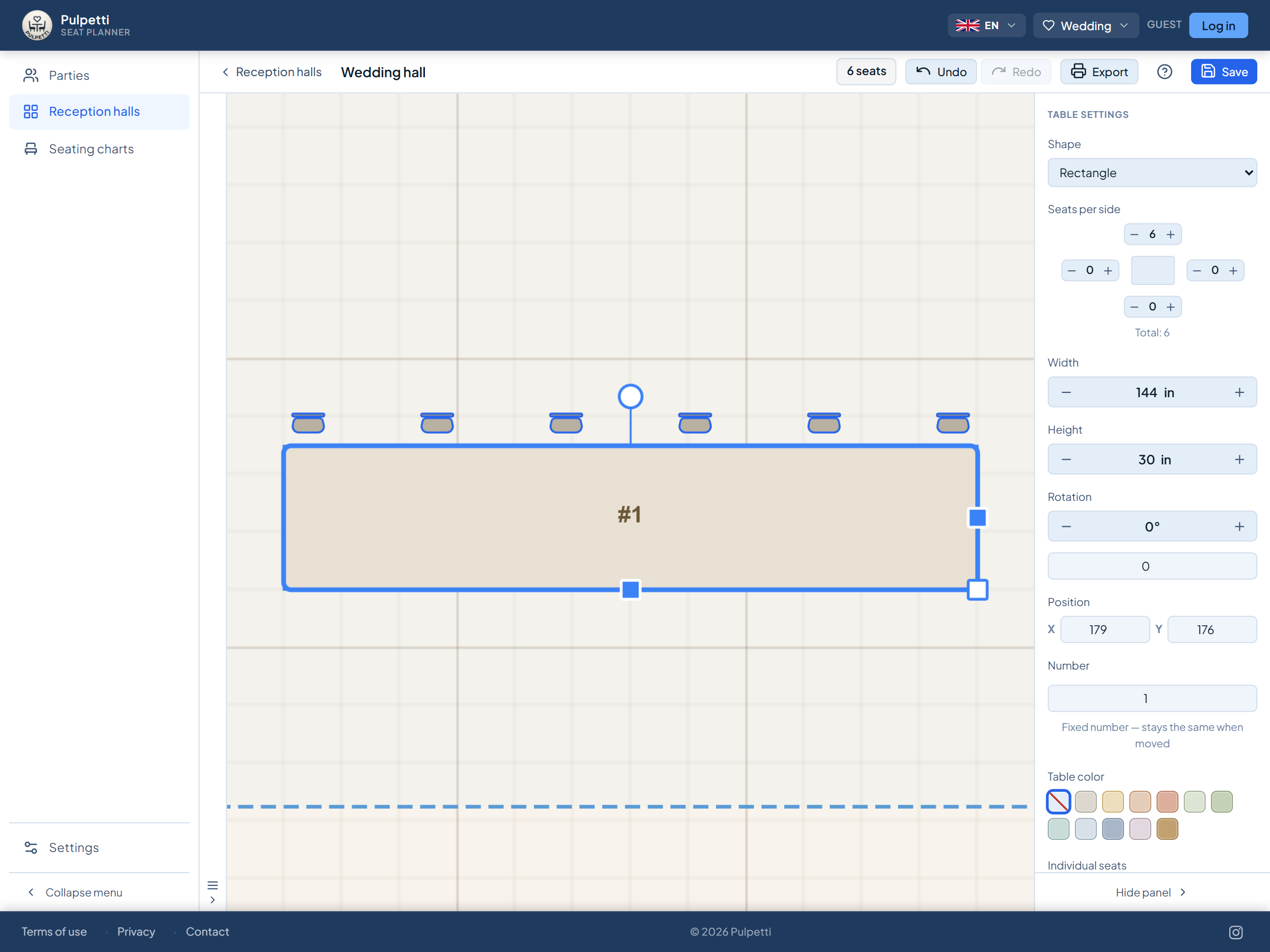
A head table is not a piece of furniture of its own but an ordinary rectangular table with the seats left on one side. In the table settings the seat count is given per side: six on one side, zero on the others. The same table turns double-sided with one number if you do end up seating people on both sides.
Pick the side facing away from the room. On a plan a seated person always faces their own table, so seats marked on the room side would put the couple between the table and the guests, with their backs to the room. The right way round, the table stands between the couple and the room, as a head table should.
The whole room comes in one go from a template: Banquet tables + head table draws the head table at the front and the numbered round banquet tables in front of it. Moving the tables into place from there is quicker than starting from an empty floor.
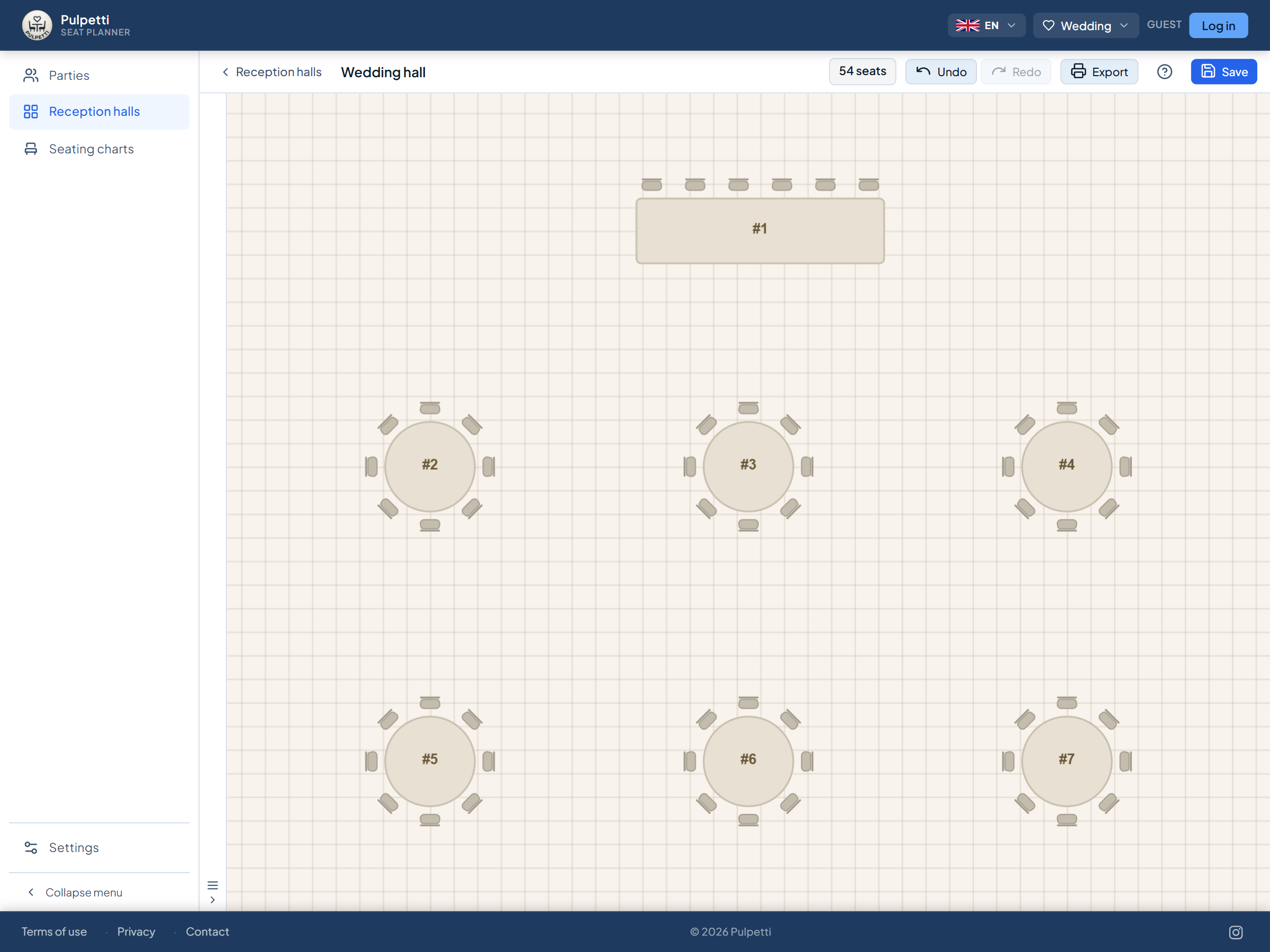
The rest is three steps:
- Place the couple and the parents by hand in the order above. When the remaining guests are drawn at random, the ones placed by hand stay where they are.
- Turn the seats that must not change into rules. The at a given table rule keeps the parents at the head table even when the chart is redrawn, and not at the same table keeps divorced parents apart without you having to remember it every time.
- Give the head table number 1. The number can be fixed so that it does not change even if the table is moved. That way the table signs and place cards stay right while the room layout is still moving.
Once the plan is ready, the same names print as place cards, table signs and a door list. The whole run of a wedding chart — groups, timing and printouts — is in the wedding seating chart guide, and the plan itself can be drawn with the wedding seating chart tool in your browser.